Monday, February 28, 2011

Wild West of Publishing?

I went to a program Saturday about the "Wild West of Publishing" in which self-publishing, print-on-demand, custom/independent publishing, traditional publishing, and electronic publishing were compared. There are definitely more publishing avenues available for authors than ever before, each with their various pros and cons.


The primary differences seem to be the cost to the author. Self-publishing, print-on-demand, custom, and electronic publishing all require the author to pay some costs up front--although these differ widely, with electronic cheapest, and custom publishing costs going up to $18,000 or higher. Traditional publishing, of course, does not cost the author up front. A possible drawback to traditional publishing is the author sells away the rights to their work and it can be costly to get them back later.

There's another consideration, however, as only books produced by traditional publishers make the author elgible to join professional organizations such as Mystery Writers of America (MWA), Science Fiction/Fantasy Authors of America (SFWA), Horror Writers Assocation (HWA). (Romance Writers of America (RWA) is a little more lenient.) Thus, although there are a lot of new publishing opportunities, maybe things haven't really changed so much.

It will be interesting to see what the future brings. What will happen to the publishing world? Will the professional organizations change with the times? What do you think?

Friday, February 25, 2011

Support your nonlocal author

I've mentioned before writers are part of a community and as such we should support each other. One way I support authors is with an ezine I founded with some writer friends in 2006. We publish short speculative fiction quarterly from authors all over the world. We have a new issue coming out February 28, 2011 some highlights of which include:


  • "The Untold Story of an Executioner" by Dawn Lloyd--a chilling tale about maybe the worst job ever
  • "End User" by A.L. Sirois--a horrific story with a character that definitely does not follow Asimov's Three Laws of Robotics
  • "Birth of a New Day" by Fredrick Obermeyer--a unique fantasy in which daybreak requires a special kind of midwife
  • "What Eats You" by Sara Kate Ellis--a near-future adventure involving role-playing and political correctness taken to the extreme
  • "Touch of Poison" by Jaelithe Ingold--a traditional fantasy in which a power struggle has a very unexpected outcome
.

Cover art by Dave Migman.

Check out ElectricSpec! It's totally free for readers. :)

Wednesday, February 23, 2011

What's your paradigm?

I went to an interesting lecture last week by famous journalist Chris Mooney. One of the things he mentioned was C.P. Snow's influential 1959 lecture "The Two Cultures" and subsequent book The Two Cultures and the Scientific Revolution. Snow claimed modern society has two different cultures, sciences versus humanities, and their lack of commonalities was a hindrance to solving the world's problems. One of Mooney's points was our society is still grappling with some of these same issues.


Unfortunately, as a writer, I also seem to be dealing with a kind of rationality versus creativity dichotomy. One of my professors said recently I was too rational and needed to be more personal in my writing. My kneejerk reaction was, how can you be too rational? And I've worked hard to train my brain to be rational. But upon reflection, I realize fiction is about people/emotions and not about data, so I may need to revisit my paradigm. Ugh.

How about you? Are you more of a rational scientist or a creative humanist?

Friday, February 18, 2011

writing goals

One of my professors, Lee McClain, led a discussion the other day about writing goals and how to meet them. One thing she said was you should have a variety of writing goals from huge to small. She said you should have giant goals (like winning a national writing award) and visualize them, to help you focus.


You should have big, but achievable goals, to work towards, and you should visualize completing them. You should also have smaller monthly, weekly, and/or daily goals and complete them. One way to meet goals is to break them down into smaller goals. And if they're still too big, break them down further. For example, say your goal is to write 5 pages a day. If you try and fail, don't beat yourself up, halve your goal: write 2.5 pages a day, etc.

The class as a whole had a lot of good ideas, too. Some people advocated writing 5 (or 10 or 15) minutes a day--no matter what. One person kept their laptop next to their bed and wrote every morning before she got out of bed. Generally, the consensus was writing, or at least thinking, about one's WIP every day was important.

How about you? What are your writing goals? How do you meet them?

Wednesday, February 16, 2011

What makes a great story?

I gave myself a little homework assignment over the holidays. I tried to find out what makes a short speculative fiction story great. I probably read over a hundred stories from those "Best of" anthologies. What did I conclude? Every great story is different, there are no hard and fast rules. Okay, in hindsight, this may be obvious. :) Another obvious thing: opinions about stories are subjective.

Here's what I took away from the exercise...

  • an excellent story engages the reader's emotions. Note, too, serious emotions such as poignancy, sorrow, or joy are more effective than humor.
  • an excellent story really tortures (figuratively, not necessarily literally) the protagonist. Often the protagonist is an underdog, starting the story behind the 8-ball (or whatever metaphor you prefer).
  • many great stories have empathetic, and even sympathetic, protagonists. Interestingly, this is one of Donald Maass' instructions in Writing the Breakout Novel.
  • many very good stories have unique voices
  • most excellent spec fic stories have fully fleshed-out worlds. The reader feels like they are actually in another place and/or time
  • most excellent stories follow the standard plot arc: the protag has a problem and acts to solve it
  • most great/excellent stories are about more than one thing and these things are interrelated. Often this involves an external and internal plot arc.
  • most great stories involve some kind of originality--a new twist on an old idea, or ideally, a totally new idea

I will continue to study the issue...

Anyone out there have any insights? What do you think makes a story great?

Monday, February 14, 2011

support your local author

I highly recommend supporting your local authors and going to their book signings. All writers are part of a community and we need to support that community to help it flourish. And don't you want your writer friends to come to your future signings? Plus, they're fun and informative.

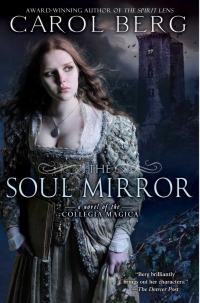
This weekend I had the pleasure of going to Carol Berg's signing for her new fantasy novel Soul Mirror. She did an intro, a reading, answered questions, and then signed books. Ooh, and she gave away chocolate! :)


Of particular interest: she had a lot to say about writing fantasy. She says fantasy encompasses every other kind of literature and is a great canvas upon which any story can be written. Fantasy enables writers to address big questions like: What is the nature of heroism? Carol also revealed the novels in this trilogy all have titles and themes related to seeing things in different ways. She also addresses the theme that people are never what they seem; all her major characters have dual identities.

Interesting! I look forward to reading the novel.

How about you? Have you been to, or held, any good book signings lately?

Friday, February 11, 2011

Deadlines rock!

Right now, I'm staring down a serious deadline for school. Many chapters of my WIP are due tomorrow! (So, of course, that calls for a blog post. :) ) As I scramble furiously to meet the deadline, it occurs to me, there's no way I would be working this hard if I didn't have to. Therefore, I can only conclude, deadlines rock! Especially for a work-avoider like me, they are invaluable.

Clever people utilize time management and prioritize and organize their work to avoid last minute scrambles and panic, as outlined in Meeting Deadlines. My biggest distraction when I'm supposed to be writing is the internet, i.e. email, googling things, blogging. So, when I really have to get things done, I have to ignore these.

How about you? What do you think of deadlines? What distracts you?

I better get back to work. :)